Quick answer
A remote bookkeeper for a US client owns a small business's books full-time: recording transactions, reconciling bank and card accounts, handling bills and invoices, and closing each month. Expect QuickBooks Online or similar software, plenty of Excel, US business hours (a night shift in the Philippines) and clear notes to the owner and their CPA.
Key takeaways
- A remote bookkeeper owns the daily books; a staff accountant adds journal entries, accruals and deeper month-end work.
- QuickBooks Online and Excel are the most common tools, and the concepts carry over between accounting systems.
- US business hours mean a night shift in the Philippines and mostly daytime hours in Latin America.
- Clean reconciliations, an on-time close and questions asked early are what make a bookkeeper stand out.
- Most bookkeeping roles don't need a US CPA license; the client's CPA makes the tax decisions.
Looking for a long-term remote role? Applying takes about 10 minutes.
See open rolesIf you have accounting or bookkeeping experience and you're looking at remote bookkeeper jobs from the Philippines or Latin America, a full-time role with a US business can be a strong next step. Small businesses in the US often need someone to own their books every day, and many would rather work with one dedicated professional than an agency that rotates people.
This guide covers what the work looks like day to day, how a bookkeeper role differs from a staff accountant role, what a shift on US hours looks like, the tools and US basics you'll need, and how to stand out when you apply.
StaffRight places full-time, long-term remote professionals with US small businesses, mostly from the Philippines and Latin America, and bookkeepers and staff accountants are among the roles we place. To see what current accounting roles ask for, see our open roles.
What does a remote bookkeeper do day to day?
The details depend on the client, but most roles include:
- Recording transactions and categorizing them correctly.
- Bank and credit card reconciliations: matching every transaction in the books to the statement.
- Accounts payable: entering bills, scheduling payments, keeping vendor records.
- Accounts receivable: sending invoices, recording deposits, following up on late payments.
- Month-end close: making sure everything is recorded and reconciled, then preparing reports.
- Reports for the owner: profit and loss, balance sheet and cash flow, often with a short note on what changed.
Bookkeeper vs staff accountant: what's the difference?
Both keep a US business's numbers right, but the scope is different.
| Bookkeeper | Staff accountant | |
|---|---|---|
| Main focus | Day-to-day transactions and reconciliations | Full-cycle accounting, from journal entries to month-end close |
| Typical tasks | Categorizing transactions, reconciliations, bills, invoices, deposits | Journal entries, accruals, reconciliations, month-end close, year-end support |
| Common tools | QuickBooks Online, Excel or Google Sheets | QuickBooks Online or NetSuite, advanced Excel |
| What job posts often ask for | Bookkeeping for US clients, QuickBooks and Excel | 2 or more years of accounting experience, depending on the role |
A staff accountant role usually adds journal entries, accruals (recording income and costs in the month they belong to, even if the cash moves later) and support for the year-end and tax work done by the client's CPA (certified public accountant). Our guide to remote staff accountant jobs covers that role in depth.
What does a remote bookkeeper's shift look like from the Philippines?
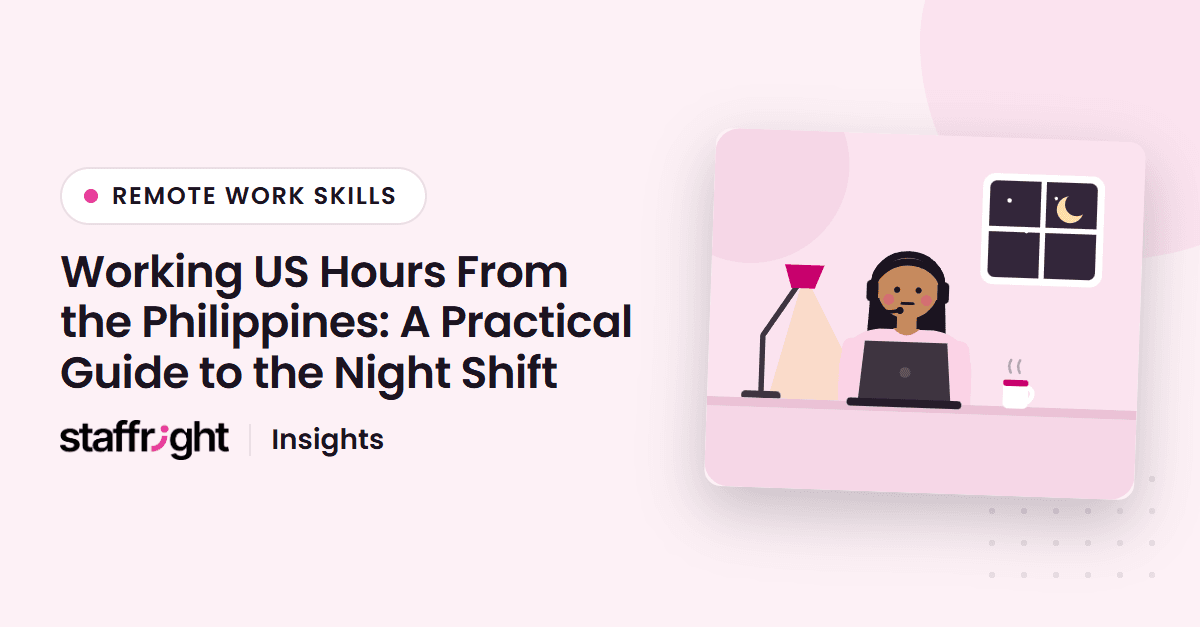
Many bookkeeping roles run on US Eastern business hours, such as 9 AM–6 PM ET. In the Philippines, that's 10 PM–7 AM Manila time while the US is on standard time (November to March), and an hour earlier while it's on daylight saving time. In much of Latin America, the same hours fall in your daytime.
Here's an illustrative shift. Say you're a bookkeeper on Eastern time, working from Manila in December:
| Manila time | US Eastern time | What you might do |
|---|---|---|
| 10 PM | 9 AM | Read messages from the owner, then pull in bank and card transactions |
| 11 PM | 10 AM | Categorize transactions and match deposits to invoices |
| 1 AM | 12 PM | Enter vendor bills and prepare the payment list for approval |
| 3 AM | 2 PM | Follow up on unpaid customer invoices |
| 5 AM | 4 PM | Work on reconciliations or month-end tasks |
| 6:30 AM | 5:30 PM | Send your end-of-shift note: done, next, and what you need |
Every client is different, but the rhythm is often similar: messages first, transactions and payables during the day, and a clear note at the end. If you're new to US hours, our guide to the night shift covers sleep, meals and routines that make it sustainable.
The tools you'll likely use
- Accounting software such as QuickBooks Online, Xero or NetSuite.
- Excel or Google Sheets, often a lot: reconciliations, schedules and reports.
- Bill pay and expense tools, depending on the client.
- Industry software, such as property management systems, when the business needs it.
- Shared drives and video calls for working with the owner and their CPA.
If you've only used one accounting system, that's usually fine. The concepts carry over, and many clients will help you learn their setup.
US basics worth knowing
You don't need to be a US CPA, but it helps to understand:
- Common US business documents: invoices, bills, receipts and W-9 forms (the form a US vendor fills in with their tax details).
- Cash vs accrual basis: whether income and costs are recorded when cash moves, or when they're earned or owed. Ask which one your client uses.
- Sales tax basics: that it varies by state, and that you follow the client's process.
- The US fiscal calendar most small businesses use: a calendar year, with tax season early in the year.
- US date and number formats: month/day/year, and commas for thousands.
- Payroll basics: many small businesses use a payroll provider, and your job is often to record payroll correctly rather than run it.
When something touches tax or legal advice, the client's CPA usually decides. Your job is to keep the books clean and flag questions early.
Bookkeeping for property management: a common specialty
Some bookkeeping roles are tied to one industry. Property management is a common one. A recent StaffRight bookkeeper role, for example, was with a US property management business, covering reconciliations, deposits and month-end close.
Property management books have a few extra pieces:
- Rent deposits from many tenants, often matched one by one.
- Security deposits, which are held for tenants and tracked separately from income.
- Owner statements for each property owner, showing income, expenses and what's been paid out.
- Vendor bills for repairs and maintenance, usually tied to a specific property.
If you have this experience, put it near the top of your CV. If you're curious about the operations side, see our guide to remote property management jobs.
A simple month-end close checklist
Month-end close is where a bookkeeper's accuracy shows. A typical checklist:
- All bank and credit card transactions recorded and categorized.
- Every bank and card account reconciled to its statement.
- Bills and invoices for the month entered.
- Accounts receivable reviewed: who owes what, and what's overdue.
- Accounts payable reviewed: what's due and what's been paid.
- Any adjustments your client or their CPA asked for recorded.
- Reports prepared: profit and loss, balance sheet, and cash flow if needed.
- A short note to the owner: what changed this month and anything that needs a decision.
What makes a remote bookkeeper stand out?
- Accuracy you can show: clean reconciliations and a close that's on time.
- Clear notes: a short summary with each report saying what changed and why.
- Questions asked early: "I found a payment I can't match. Can you tell me what it was for?"
- Organized files the owner or CPA can find in seconds.
- Care with private data: you see a business's bank details, so you keep them inside the client's systems.
And a few mistakes to avoid: guessing a category instead of asking, leaving reconciling items unexplained month after month, sending reports with no note, and keeping client files in personal email or storage.
Bookkeeping and accounting roles at StaffRight
We place bookkeepers and staff accountants with US small businesses, full-time and on US business hours. You sign a contract with StaffRight LLC and work 40 hours a week, Monday to Friday, with one US client.
Recent accounting roles have included:
- Bookkeeper (Philippines): keeping the books for a US property management business, from reconciliations and deposits to month-end close, on 9 AM–6 PM ET.
- Staff Accountant (Philippines): day-to-day accounting in NetSuite, from journal entries and reconciliations to month-end close.
- Staff Accountant, bilingual (Latin America): full-cycle accounting in QuickBooks Online for professionals who speak English plus Spanish or Portuguese, open in Argentina, Brazil, Colombia, Ecuador, Mexico and Nicaragua.
Open roles change, so see current openings for what's available now. You can also read about our perks and benefits.
Open roles that match this article
Open roles change often. Applying takes about 10 minutes, and you'll hear back within 3 business days.
Staff Accountant
- 9 AM–6 PM ET
- 10 PM–7 AM Manila
- Philippines
- Work from home
What you’ll need
- 3+ years of accounting experience
- NetSuite, plus Excel or Google Sheets
- Excellent written and verbal English
How do you apply for a remote bookkeeping role?
- Update your CV so your accounting software, Excel, reconciliations and any US-hours experience sit near the top. Our CV guide for remote jobs shows how.
- Record a 1–2 minute intro. Say what you do, the software you use and what you're looking for.
- Check your setup: a reliable computer, stable internet and backup power. If you don't have a backup yet, you can still apply, and you'll have about 2 weeks to get it.
- Apply. It takes about 10 minutes, and we reply to every applicant within 3 business days. Most people go from application to offer in 2–3 weeks. Our guide to the StaffRight hiring process explains every step.
Frequently asked questions
Do I need a CPA license for a remote bookkeeping job?
Usually not for bookkeeping roles. Staff accountant roles may ask for an accounting degree or a set number of years of experience. The job post says what's required.
Is QuickBooks experience required for remote bookkeeper jobs?
It's common, and many bookkeeping roles ask for QuickBooks and Excel. If you know another system well, such as Xero or NetSuite, say so. The concepts carry over.
Can I apply if I've only worked for a Philippine company?
Yes, but many roles ask for at least 1 year working US business hours. Check the must-haves in each post, and put any US-hours or US-client work near the top of your CV.
What's the difference between a bookkeeper and a staff accountant?
A bookkeeper owns the daily books: transactions, reconciliations, bills and invoices. A staff accountant adds full-cycle accounting, such as journal entries, accruals and month-end close, and often works more closely with the client's CPA.
What hours do remote bookkeepers work for US clients?
US business hours, often 9 AM–6 PM Eastern time. In the Philippines, that's a night shift: 10 PM–7 AM Manila time while the US is on standard time. In much of Latin America, it falls mostly in the daytime.
Do I need to know US tax law?
Not in depth. It helps to know the basics, such as W-9 forms and that sales tax varies by state, but the client's CPA makes the tax decisions. Your job is to keep the books clean and flag questions.
Can I work as a remote bookkeeper from Latin America?
Yes. Some accounting roles are open to professionals in Latin America, including bilingual staff accountant roles for people who speak English plus Spanish or Portuguese. Each job post lists the countries it's open to.
Ready to take the next step?
If you're ready to own a client's books, see our open accounting and bookkeeping roles. Applying takes about 10 minutes. If nothing matches right now, leave your email in the "Get new roles first" box below, and we'll email you when a matching role opens. Know a great bookkeeper? You can refer a friend.
Get new roles first
No role that fits today? Leave your email and we'll let you know when a matching role opens.